Electrochem Seminar - "Nanoscale Chemical Characterization Of Early Stages Of SEI In Li Metal Anodes" - Asia Sarycheva
Electrochem Seminar - "Nanoscale Chemical Characterization Of Early Stages Of SEI In Li Metal Anodes" - Asia Sarycheva
Abstract
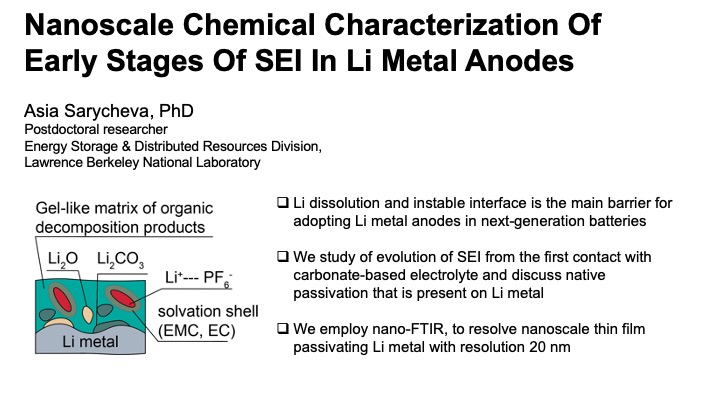
Chemical instability and high impedance at the interface of Li-metal electrodes limit the electrochemical performance of high-energy-density batteries. In order to overcome this challenge, it is paramount to understand the composition of the interface of lithium and electrolytes. The SEI layer chemistry is known to be highly complex and heterogeneous at the sub-nanometer scale, the exact function of its constituents remains poorly understood. SEI layer composition and mechanical properties affect coulombic efficiency, therefore it is paramount to understand the passivation layer on lithium metal on the nm-scale to fully understand the complex chemistry of the passivation layer. There have been numerous studies to analyze SEI on Li metal anodes: the passivation layer consists of irreversibly-plated Li, also known as “dead Li”, inactive ~100 nm-thick SEI layer, and the active passivation layer between Li metal and inactive SEI
The thickness and domain size of SEI components dictates the use of instrumental techniques beyond the diffraction limit. Generally, such techniques involve a high vacuum in order to achieve such a resolution. Transmission and scanning electron microscopies, TEM and SEM, have been used as tools to observe the nucleation process during Li plating and subsequent growth of lithium dendrites, the main culprit in safety issues of LIB. However, more ambient conditions are necessary to analyze the pristine initial SEI layer. However, with the recent development of scattering-type Scanning Near-field Optical Microscopy (sSNOM), it is possible to image the chemical nature of the SEI layer in sub-diffraction limit in ambient conditions, which we applied to Li metal battery system.
Due to the reactivity of Li metal, it is important to ensure the cleanliness of the prepared Li metal foil to avoid any potential contamination, especially from volatile organic compounds (VOC), present in the majority of liquid battery electrolytes. In our study, we used battery grade GEN 2 electrolyte (EC/EMC 1.2 M LiPF6). To address this issue, we have developed a transfer method ensuring the pristine condition of the Li surface before coming in contact with the electrolyte. A thin film, formed upon contact with the electrolyte on the Li metal surface passivates the surface and presents as an initial SEI layer. By using nano-FTIR spectroscopy we revealed the chemical composition of the GEN2/Li surface.
We have also shown the evolution of morphology and chemical composition of the SEI layer beyond the diffraction limit, reaching 20 nm resolution. We have conducted our experiments at Advanced Light Source (ALS) Beamline 2.4 (Synchrotron Infrared Nanospectroscopy (SINS) and Imaging), using a bright and broadband infrared light source and a detector that allows probing vibrations at a lower cutoff frequency ~350 cm-1, which opens a unique opportunity to probe inorganic SEI components by nano-FTIR spectroscopy. We revealed the evolution of the initial SEI layer in Li-metal anodes as well as the passivated surface of plated Li “Dead Li”. Obtained knowledge brings us closer to the understanding of the early evolution of the Li metal battery interface.
Speaker
Asia SarychevaAsia (Ah-see-ah) is a Postdoctoral Researcher in the Energy Storage and Distributed Resources Division of Lawrence Berkeley National Laboratory (LBNL). Her research interests include understanding interface chemistry through nanoscale imaging and vibrational spectroscopy. In her role as a Postdoctoral Researcher at LBNL, she investigates the early stages of the solid electrolyte interphase (SEI) formation in Li-ion batteries using in situ sSNOM-based infrared nanospectroscopy. Asia received a Ph.D. in Material Science and Engineering in 2021 under the supervision of Professor Yury Gogotsi at Drexel University and M.Sc. in Chemistry from Moscow State University. Her doctoral work involved understanding and interpreting Raman spectra of 2D materials MXenes (a class of two-dimensional transition metal carbides and nitrides). During her doctoral work, she developed MXene Surface-Enhanced Raman spectroscopy (SERS) sensor, MXene-based electromagnetic speakers, and MXene-based antennas.